René Descartes walks into a bar and orders a drink. When he finishes his drink, the bartender asks him if he would like another. Descartes replies, “No, I think not,” and disappears in a puff of logic.
Philosophers are probably not amused… not because the joke talks crap about Descartes (it doesn’t), but because its attempt at humor rests on a misunderstanding of basic logic. In fact, there are two fallacies at play here: equivocation and denying the antecedent.
Equivocation
Equivocation is a fallacy where a word or phrase has two different meanings that are mistakenly lumped together as one. This is an informal—not formal—fallacy. That is, the fallacy arises not from the logical form of the argument, but from the content of the argument. Take this meme:
The Bible says being gay is fine, as long as you’re high.
Why? Because…
“A man who lays with another man should be stoned.”
–Leviticus 20:13 ESV
The fallacy hinges on a (deliberate) equivocation on the word “stoned,” which can mean two things: (1) to be high and (2) to be executed by stoning.
Applied in a deductive argument, equivocation might look like this:
Premise 1: Saint Stephen was stoned.
Premise 2: If you’re stoned, you’re allowed to be gay.
Conclusion: Therefore, Saint Stephen was allowed to be gay.
Here, the form of the argument is what we call modus ponens, a deductively valid move in logic. But the content of the argument—specifically, the two distinct meanings of “stoned” in the premises—is conflated, creating an informal fallacy.
Equivocation in the Descartes joke
So where does equivocation fit in the Descartes joke?
“I think not.”
This has two different meanings:
“I think not”1 = “I don’t think so”
“I think not”2 = “I am not thinking”
The joke exploits this ambiguity, going from “I think not” in the first sense to “I think not” in the second.
Denying the antecedent
This is where it gets pretty stupid. Besides equivocation, the fallacy of denying the antecedent—a formal fallacy—must be applied for the joke to work at all.
Briefly:
Denying the antecedent:
P → Q
¬P
∴ ¬Q
This says:
If P, then Q
Not P
Therefore, not Q
This is invalid because Q could still be true for some other reason. But it’s a tempting mistake. Some instances of denying the antecedent look convincing at first glance:
Premise 1: If I die, I’ll be in hell.
Premise 2: I’m not dead.
Therefore, I’m not in hell.
But the fallacy becomes more obvious once we change the content:
Premise 1: If that’s a turtle, then that’s a reptile.
Premise 2: That’s not a turtle.
Therefore, that’s not a reptile.
Clearly, an animal can be a reptile without being a turtle.
In the case of the Descartes joke, the implied argument is:
If I think, I exist.
I think not (that is, I am not thinking).
Therefore, I don’t exist.
Same form, different content.
So there you go—a seemingly funny joke ruined by a brief logical analysis, which I find funnier than the joke itself.
And they say that Descartes “disappears in a puff of logic”?
Philosophers draw a distinction between formal fallacies and informal fallacies.
Formal fallacies
Roughly, a formally fallacious argument is a deductively invalid argument where the form of the argument is wonky. Take, for example:
Premise 1: If I have COVID, then I display symptoms X.
Premise 2: I display symptoms X.
Conclusion: Therefore, I have COVID.
The form of this (bad) argument is:
C → D
D
Therefore C
Note that the conditional (if…then) is symbolized by an arrow going from left to right. That means C gets you D. But that doesn’t mean D always gets you C.
For instance, if it’s true that having COVID implies that I display symptoms X, I can’t conclude from the fact that I display symptoms X that I have COVID—because after all, I might have some other non-COVID lung problem that’s causing those symptoms.
And sure, it might also turn out that I do have COVID after all, but that possibility doesn’t make the argument any less fallacious. The problem is not that the conclusion happens to be false. The problem is that the form of the argument allows for a case where the premises are true and the conclusion is false. That is what makes it deductively bad. So:
fallacy ≠ false
formal fallacy = a deductive argument whose form does not guarantee the conclusion
Here’s another example:
Premise 1: If that’s a dog, then that’s a mammal.
Premise 2: That’s a mammal.
Conclusion: Therefore, that’s a dog.
The form here is identical to the (bad) argument about COVID. We have:
D → M
M
Therefore D
But this one is very obviously fallacious.
Again, it’s fallacious not because the conclusion happens to be false (it might very well turn out that the mammal is a dog), but because even if the premises are all true, you still can’t say for certain that the conclusion is true.
Informal fallacies
So where do informal fallacies come in?
Take something that is, in classical logic, both necessarily true and formally correct:
A = A
or
A
therefore A
And say that someone asks you this:
“Who is the current president of the United States?”
You respond with this argument:
John Adams is the current president of the United States. Why? Because John Adams is the current president of the United States.
That’s stupid—not because there’s anything wrong with the form of the argument, which is simply A, therefore A, but because the argument is rhetorically useless and question-begging. It gives the hearer no independent reason whatsoever to accept the claim.
So the John Adams argument is stupid due to something that logical form alone cannot capture, namely, some conversational, rhetorical, epistemic (knowledge), or other informal aspect of language itself.
Or take this example, taken from an old DirecTV commercial:
“When you pay too much for cable, you feel down. When you feel down, you stay in bed. When you stay in bed, they give your job to someone new. When they give your job to someone new, he has a lot to learn. When he has a lot to learn, mistakes are made. And when mistakes are made, you get body-slammed by a lowland gorilla. Don’t get body-slammed by a lowland gorilla. Get rid of cable, and upgrade to DirecTV.”
The chain part of the argument has a deductively valid form. It’s basically:
A → B
B → C
C → D
D → E
E → F
F → G
So:
A → G
Now, to get from there to “therefore don’t pay too much for cable,” you need at least one additional premise—something like this:
¬G
Therefore ¬A
And even if you generously grant the commercial that extra anti-gorilla premise, what’s still fallacious is not the logical form. The form is fine. What’s fallacious is the evidentiary stuff: the more links you have in a chain argument, the more evidence you need to justify each link. Is there enough evidence to say that “when mistakes are made, you’ll get body-slammed by a lowland gorilla”? No. And the same goes for several of the other links.
Where the line blurs
An interesting issue arises when we consider borderline cases of fallacies. Take this one:
Premise 1: Some dogs bark.
Premise 2: Guai Guai is a dog.
Conclusion: Guai Guai (probably) barks.
It’s unclear whether this is best treated as formally or informally fallacious.
The case for “formally fallacious”
If we ignore the word “probably” and interpret this as a deductive argument, the argument is deductively invalid because the form does not guarantee the conclusion.
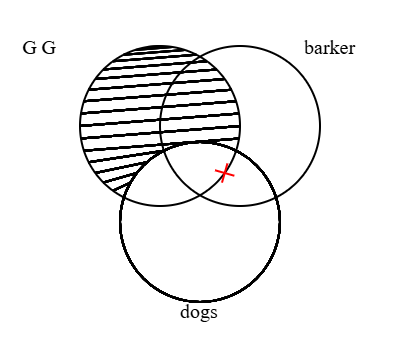
You can illustrate that with a neat little Venn diagram like this one.
The red X in the overlap of the dog-circle and barker-circle stands for premise 1: some dogs bark.
But that X only tells you that at least one dog is in the barking region. It does not tell you which dog.
Premise 2 tells you that Guai Guai belongs somewhere inside the dog-circle. But it does not force Guai Guai into the overlap. Guai Guai could be in the barking part of the dog-circle, or in the non-barking part of the dog-circle.
That is the crux of the problem: even if the premises are true, the conclusion “Guai Guai barks” is still not guaranteed to be true.
If you’re not familiar with predicate logic, ignore the next few lines. But if you do know it, you’ll see the point immediately:
∃x(Dx ∧ Bx)
D(g)
Conclusion: B(g)
That inference is not deductively valid. The existential premise says that some dog barks. It does not say that this particular dog, namely Guai Guai, barks.
The case for “informally fallacious”
Now this is where things get messy. If we interpret the Guai Guai argument not as deductive (an argument that attempts to conclude that something is logically guaranteed to be true if the premises are all true) but as inductive (an argument that attempts to conclude that something is more likely true than not—in short, a probabilistic argument), then the defect seems to be evidentiary rather than purely formal.
Revisit the argument:
Premise 1: Some dogs bark.
Premise 2: Guai Guai is a dog.
Conclusion: Guai Guai probably barks.
If “some” turns out to mean “just one dog” (which it might, because “some” means at least one), then the conclusion that Guai Guai probably barks is supported by very weak evidence.
On the other hand, if “some” turns out to mean “99% of dogs” (which is also consistent with the word “some”), then that would be enough evidence to support the conclusion that Guai Guai probably barks.
This suggests that once we explicitly add the word “probably,” the argument is no longer best criticized as a deductive screw-up. Instead, the problem is that the evidence may be too weak to support the probabilistic conclusion. That makes the defect look informal rather than formal.
So what?
The problem with this borderline case is that intro-level logic teaching often makes the formal/informal divide sound cleaner than it really is.
Intro logic books often focus on a small handful of named formal fallacies, such as:
affirming the consequent (the COVID argument form)
denying the antecedent
undistributed middle
Possibly that’s because such fallacies are common, psychologically tempting, and canonically named.
But I don’t think fallacies have to be common or psychologically tempting to count as fallacies; they just have to be logically or linguistically defective. And that whole “canonically named” thing? That starts to smell a bit like dogma.
And even if broadening the term “formal fallacy” ends up making that category messier than philosophers would like, so what? If a counterexample makes the old definition unstable, that doesn’t show that the counterexample is bad. It might just show that philosophers’ understanding of the formal/informal divide is wonky and needs revision.
That’s my spiel for today. Keep thinking (and arguing).
I’m going to attempt the impossible in this post: explain something that confused me and pissed me off so much in grad school that it became one of the (many) reasons I quit the program. But it’s been a decade since I left, and now that there’s no pressure to publish papers, meet deadlines, and pass the damn courses, it’s time to revisit this shit with a vengeance.
Metalogic — what in the actual fuck does that even mean?
We’ll lay down some foundational metalogic concepts first so we can tackle what’s called the soundness theorem in metalogic within what’s called the Hilbert system, not just as a vague example, but with as much precision as possible—while translating every piece of symbol garbage into normal human English.
The calculator analogy
Say you have a calculator.
2 + 2
and it spits out:
4
Cool. That’s just doing math.
That’s like doing a normal logic problem: you follow rules → you get an answer.
But metalogic asks something way more annoying:
“How do you know the calculator won’t randomly give you 5 or 10 or 17 one day?”
Not just for 2 + 2.
But for:
17 + 83
999 + 1
ANY numbers you plug in
So we’re not checking answers.
We’re checking whether the system itself ever screws up.
What we need to show
To prove the system is reliable, we need four things:
Premises
Axioms
Rule Case
Inductive Step
I’ll explain what the hell these things mean using analogies along the way.
(1) Starting assumptions (premises)
These are just things you’re told to start with.
Math analogy:
You get a math problem. It says assume that x = 5.
You don’t question the math problem and say shit like, “How do you know that x = 5? Can you prove it? No? Then shut the fuck up.”
Instead, you say, “Cool, let’s just say that x = 5 is true.”
Chess analogy:
Say that you’re playing a game of chess. You’re given a starting position: the white queen is on one square, the black queen is on another, the rooks are in the corners, and so on. You don’t say, “How do we know that’s where these pieces begin?” You just assume those positions are correct and move on.
Logic example:
Statement 1: If you eat Taco Bell, you’ll have diarrhea.
Statement 2: You eat Taco Bell.
…you don’t question whether these two statements are true. You assume they’re true for the sake of argument. If we want to add a few scary logic symbols, we write:
Γ = { Taco Bell, Taco Bell → diarrhea }
Translation (without the hieroglyphics)
Γ (the big scary Greek letter gamma) just means:
“the set of starting assumptions”
So this is just a fancy way of saying:
“Here are the things we’re starting with. This is like ‘assume x = 5’ in a math problem or a given starting position in a game of chess. Don’t question them (for now).”
Even simpler
Γ =
Taco Bell
If Taco Bell → diarrhea
That’s it.
No magic.
Important clarification (so nobody loses their mind)
We are NOT saying:
“Taco Bell is actually true in real life”
We are saying:
“Assume it’s true. Now let’s see what follows.”
One-line takeaway
Premises are just the starting point of the game—not guaranteed truth, just assumed truth.
(2) It starts with stuff that can’t be wrong (axioms)
Axioms are different from premises.
Premises are just assumptions you start with.
Axioms are patterns that come out true no matter what you plug into them.
Math analogy:
x = x.
No matter what number you plug in for x, it always comes out true. There is no situation where a thing is not equal to itself.
Chess analogy:
There are some things built into the chess system itself. One piece can’t occupy two squares at once. Two pieces can’t occupy the same square. If that happened, the game would already be broken before it even began.
Now here’s where my past self would start getting pissed off:
“Why the fuck are we allowed to just say this can’t be wrong? Aren’t we just assuming that?”
That sounds like what’s happening—but that’s not actually what’s going on. In logic and metalogic, it has something to do with a possible situation.
What the hell is a “possible situation”?
In logic, a “possible situation” does NOT mean:
some weird sci-fi universe
or “anything you can imagine”
It means something much more boring:
a way of assigning true or false to statements
That’s it.
That’s what truth tables are doing.
So we’re not assuming—it’s more like checking every possible truth assignment
Take a typical logical axiom:
“If A, then (if B, then A)”
Now we check ALL possible truth assignments:
A
B
B→A
A→(B→A)
T
T
T
T
T
F
T
T
F
T
F
T
F
F
T
T
This means:
If A = true and B = true, then A→(B→A) is true.
If A = true and B = false, A→(B→A) is still true.
If A = false and B = true, A→(B→A) is true yet again.
If A = false and B = false, A→(B→A) is true too.
We’ve exhausted all the possible situations, or all possible truth assignments. Whatever true/false shit you might assign A and B, A→(B→A) always comes out true.
In other words:
Does this thing EVER come out false?
No.
Not even once.
So we’ve proved that this is a legit axiom. That means we’ve proved that what we’re starting with can never spit out garbage.
Important clarification
You might say, “Hey, dumbass, what if I define a situation where A and ¬A are both true?”
For example:
A
¬A
T
T
F
F
Cool.
But then:
you’ve changed the rules of the game
You’re no longer doing classical logic.
And if you change the rules, then yes:
you have to redo the whole soundness proof for that new system
Final translation of “axiom”
Axioms aren’t trusted because we feel like it. They’re trusted because, given the system’s definition of truth, we can check every possible case—and they never come out false.
(3) The rules never mess things up (rule case)
Now we check the rules.
Math analogy:
Suppose you know:
2 + 2 = 4
4 + 4 = 8
Now you apply a rule:
“If a = b, then you can replace a with b”
So from:
2 + 2 = 4
you’re allowed to treat 4 as interchangeable with 2 + 2.
So (2 + 2) + 4 = 8.
This math rule never messes up.
Chess analogy:
Bishops move diagonally.
So if your bishop starts on a black square, it will always stay on black squares.
And if your bishop starts on a white square, it will always stay on white squares.
So the rule “bishops move diagonally” will never randomly make a bishop jump from a white square to a black square, or from a black square to a white square, or do some other crazy shit.
In logic, here’s the big rule:
Modus Ponens
A
If A → B
Therefore:
B
Concrete example
Metalogic is gay.
If metalogic is gay, Raymond’s ass is demolished.
Therefore:
Raymond’s ass is demolished.
Now here’s the important part
This isn’t about THAT specific sentence.
It’s about the form.
You can swap in anything:
Example 2
You eat Taco Bell.
If you eat Taco Bell, you’ll have diarrhea.
Therefore:
You’ll have diarrhea.
Example 3
I didn’t sleep.
If I didn’t sleep, I’m miserable.
Therefore:
I’m miserable.
Example 4
I make poop jokes.
If I make poop jokes, I’m childish.
Therefore:
I’m childish.
The key question
Is there ANY situation where:
A is true
“If A then B” is true
but B is false?
No.
There is no such situation.
Again, in intro to logic class, you can use a truth table to check this:
A
B
A → B
T
T
T
T
F
F
F
T
T
F
F
T
The only row where A is true and A → B is true is the first row. And in that row, B is true too.
Therefore:
This rule NEVER turns truth into bullshit.
(4) If every step is good, the whole thing is good (inductive step)
This is where grad school says:
“We proceed by induction”
and everyone (well, me, at least) dies inside.
Again, we’ll first use the math analogy.
Start with:
2 + 2 = 4
4 + 4 = 8
8 + 8 = 16
Notice something:
You’re always adding an even number to an even number.
And every time:
you get an even number
Now the key idea
If:
even + even = even (this NEVER fails)
Then:
no matter how many times you repeat this process, you’ll ALWAYS get an even number.
That’s the inductive step
You’re not checking:
just the first step
just the second step
You’re saying:
“This pattern keeps working forever.”
And how do we know it works forever? We know not because we’ve checked a bunch of numbers and got tired and said, “Fuck it, it works for all numbers for infinity.” It works because we get the form of the math. That is,
2a + 2b = 2(a + b)
Steel staircase analogy:
You’re building an infinite staircase. The first step you build is made of solid steel. It doesn’t collapse. The second step is built the exact same way. It doesn’t collapse. The third step is also built identically to the second. So it’s impossible for the entire staircase to collapse.
Why?
Not because you checked a few steps and said, “Cool, it works for all the steps.” It’s because the way each step is built is identical to the next.
Chess analogy:
If every move you make is legal, and every move is made according to the same rules, then the entire game stays legal. The board won’t suddenly sprout a third king or summon a UFO to suck away your pieces halfway through the game.
Translation
If every step in your reasoning is safe, then the final result is safe.
Conclusion
If your eyes glazed over, don’t worry. Just keep this in mind:
Every line in a logical proof is either:
a given assumption/premise (like x = 5)
an axiom (like If A, then (if B, then A))
the result of applying a rule (like modus ponens)
And induction is the method that lets us say:
if every step is safe, then the whole proof is safe
So if premises don’t start us with bullshit, axioms never spit out bullshit, and rules never turn truth into bullshit, then the whole logical system we’re checking is legit.
In other words:
If you can prove it (using the logical system you’re checking) (⊢), it’s true (⊨).
That’s all for today. In a future blog post, I’ll take you through the proof for the soundness theorem step by step, using the Hilbert system.
“Deductive arguments go from general to specific.” “Inductive arguments go from specific to general.”
This is repeated so often that even professors say it.
Unfortunately, it’s wrong.
And if I hear one more person say that, I’m gonna have a fucking seizure.
First: what an argument actually is
An argument = a set of statements, a.k.a. premises, that lead to a conclusion.
So this is an argument:
Premise 1: If I hear one more person say “deductive arguments go from general to specific,” I’m gonna have a fucking seizure.
Premise 2: I hear one more person say “deductive arguments go from general to specific.”
Conclusion: Therefore, I’m gonna have a fucking seizure.
The form, or structure, of the argument is:
H → S
H
Therefore, S
That logical move, by the way, is called modus ponens. It’s a valid and “duh” move, yes, but the Latin makes it sound deep, and it’s exactly the kind of structure all deductive logic is built on.
In logic, an argument is NOT defined as:
yelling
a claim (like “postmodern art is valuable, but postmodernism is not”–sounds deep, but that’s just a claim/statement)
an opinion (including the ones everyone and their uncle feel entitled to express)
disagreement
What deduction REALLY is
Deductive validity
Deduction means:
If the premises (of an argument) are true, then the conclusion must be true.
In other words:
The truth of the premises guarantee the truth of the conclusion.
So, if ‘H → S’ (premise 1) is true, and if H (premise 2) is true, then S (conclusion) must be true.
Specifically, that’s what we call a deductively valid argument.
Notice I kept on italicizing the word if. That’s because that’s super important–after all, one or more of these premises might not be true. For example, is premise 2 (“If I hear one more person say “deductive arguments go from general to specific,” I’m gonna have a fucking seizure”) true? No. So deductive validity doesn’t mean that the conclusion of your argument is true. It just means, again, that
if the premises are all true, then the conclusion must be true.
Deductive soundness
But what if you have a valid argument and its premises are all true? For example:
Premise 1: If I don’t have any money, I can’t pay the mortgage. (TRUE)
Premise 2: I don’t have any money. (TRUE)
Conclusion: I can’t pay the mortgage. (BOTH LOGICALLY AND IN REALITY GUARANTEED TO BE TRUE)
Then this deductive argument is what is called sound.
A word on that bullshit definition of “deduction”
Note that in neither the seizure example nor the mortgage example is anything “going from general to specific.” That’s because “going from general to specific”is simply not the correct definition of “deduction,” nor is it useful for a deeper understanding of how arguments work. But some teachers and professors will still use that definition no matter how many times I object. Whatever. Let’s move on.
What induction REALLY is
Inductive logic does not use labels like “valid” or “sound.” Instead, we use words like “weak,” strong,” and “apt.” This different terminology is important because, unlike deduction, induction is probabilistic.
Inductive weakness
Consider this argument:
Premise 1: Some dogs bark.
Premise 2: Guai Guai is a dog.
Conclusion: Guai Guai (probably) barks.
This is an inductively weak argument becauseof what the word “some” means.
“Some dogs” might be just 1% of dogs. “Some dogs” might even be just 0.01% of dogs. There simply isn’t enough reason for us to accept the conclusion that Guai Guai probably barks because, by definition, probably = roughly put, “more likely than not” or “high enough likelihood given the evidence.” And the word “some” is simply too weak to conclude that Guai Guai’s barking is probable.
Inductive strength
Now what about this one?
Premise 1: Most Martians like Dr. Seuss.
Premise 2: Zorp is a Martian.
Conclusion: Zorp (probably) likes Dr. Seuss.
This is an inductively strong argument. “Most Martians” doesn’t mean some exact math like 51%. It just means a strong majority—enough to make the conclusion actually likely. So that–and the fact that Zorp is a Martian–makes it probable that Zorp likes Dr. Seuss.
Inductive aptness
What happens when you have an argument that is inductively strong and all its premises are true? That’s when you have an inductively apt argument. Let’s go back to the dog argument and change it a little:
Premise 1: Most dogs bark.
Premise 2: Guai Guai is a dog.
Conclusion: Guai Guai (probably) barks.
This dog argument has a form that is identical to that of the Martian argument, so it is obviously inductively strong. But unlike the Martian argument, the dog argument has premises that are all true. Hence, it is inductively apt.
A word on that bullshit definition of “induction”
Note that none of these inductive arguments “go from specific to general.” That’s because, like the bullshit-y definition of deduction, the bullshit-y definition of induction is not very helpful for a deep understanding of how arguments work. And yet, textbooks teach that definition. Perhaps I will be having that fucking seizure after all.
Another type of argument: abduction
There’s at least one other type of argument–the abductive argument–that we can discuss. Abduction, or inference to the best explanation (IBE), aims to reach conclusions based on the best possible explanation. Ockham’s Razor–the principle that the best explanation is the simplest one that makes the least number of assumptions–is a case in point. For instance:
Suppose you walk into your living room and see that:
The floor is wet
Your dog is shaking water everywhere
There’s a knocked-over bowl of water
You could come up with many explanations:
A pipe burst
Someone broke in and spilled water
Your dog knocked over the bowl
But one explanation stands out as the best:
Your dog knocked over the bowl and made a mess.
That’s an abductive argument:
The floor is wet and the bowl is knocked over. If the dog knocked over the bowl, that would explain all this shit. Therefore, the dog probably knocked over the bowl.
Notice what’s happening here:
You’re choosing the explanation that best fits the evidence.
A brief note on abduction and probability
Abduction is often treated as probabilistic, even if people don’t always say it that way.
When you say “this is the best explanation,” what you usually mean is something like:
This explanation makes the observed evidence more likely than the alternatives.
That’s exactly the kind of reasoning philosophers like Elliot Sober analyze using probability. (Check out his book, Ockham’s Razors.)
So if someone tells you that abduction is “not probabilistic,” they’re either oversimplifying or just wrong.
Conclusion
If you forget most of what I just said, remember this one thing:
The difference between deductive and inductive arguments has nothing to do with “general vs. specific.” It has to do with certainty vs. probability.
I’m not going to teach you how to do logic in this post. That would take many hour-long lessons just to cover the tip of a dick-shaped iceberg called “logic.”
Instead, I want you to be able to recognize different types of logic, the same way you can recognize German, Spanish, Arabic, Mandarin, and Korean—even if you don’t actually speak any of them.
Most people hear the word “logic” and immediately check out. Their brain goes:
“Hey, did you know there’s a sneaker sale this weekend?”
But fuck that. Logic is about clear thinking, and clear thinking is basically a superpower.
So let’s at least figure out what the different “dialects” of logic even are. We will briefly discuss the gist of:
Classical Logic
Modal Logic
Intuitionistic Logic
Relevance Logic
Paraconsistent Logic
and bestow honorary mention on fuzzy logic at the end.
1. Classical Logic (The Default Setting)
This is the one most people unknowingly use.
It has two big rules:
(1) Big Rule 1: No contradictions allowed
You cannot have:
“Pringles are good” and “Pringles are not good”
both true at the same time, in the same sense.
This is called the Law of Non-Contradiction.
(2) Big Rule 2: No middle ground
A statement is either:
true, or
false
No in-between. No “kinda true.”
This is called the Law of Excluded Middle.
The really crazy rule: explosion
If you do allow a contradiction:
P and not-P
then everything becomes provable.
Yes—literally anything.
Example of Explosion
Start with:
It is raining AND it is not raining
From this, we can get:
It is raining It is not raining
So far, so normal.
Now here’s the key move:
From:
It is raining
you can say:
It is raining OR the moon is made of cheese
(This is called addition—and yeah, it’s weird but legit.)
Now combine that with:
It is not raining
And use a rule (disjunctive syllogism):
If:
A or B
not A
Then:
B
So:
“It is raining OR the moon is made of cheese”
“It is not raining”
Therefore:
The moon is made of cheese
Boom. You just “proved” nonsense.
Moral of the story:
Contradictions break the system.
This is called:
Ex Falso Quodlibet
aka Explosion
One-liner:
Classical logic = “No contradictions, no gray area, or everything goes to shit.”
Now we level up.
Instead of just asking:
“Is this true?”
we ask:
“Does this HAVE to be true?” “Could this be true?”
2. Modal Logic (Must / Might Logic)
While classical logic talks about things like what is actually true (like the fact that many Singaporean drivers are assholes), modal logic talks about things like:
You must wear a seatbelt.
Some Singaporean drivers might be assholes.
Some car accidents could happen
Classical logic is like:
“Cool story, but I only understand true/false.”
Modal logic is like:
“Let’s handle that shit properly.”
The Two Main Modal Words
□ (box) = MUST / necessarily
◇ (diamond) = POSSIBLE / maybe
Here’s a simple application to get you started:
□A = “A has to be true in all the situations we’re considering”
◇A = “A could be true in at least one situation”
And here’s an example:
“The toilet must be clogged.”
This means: in every possible situation we’re considering, the toilet must be clogged.
Here’s another one:
“The toilet might be clogged.”
This means: there is at least one possible situation where the toilet is clogged.
The key idea: “possible worlds”
This is the weird part, but we’ll keep it simple.
Modal logic imagines:
different ways reality could be
Not sci-fi necessarily. Just:
what might be true
what could have been true
what has to be true
Think of:
different “versions of reality”
Like:
World 1: it’s raining
World 2: it’s sunny
World 3: it’s cloudy
Now define the operators
◇A (possible A)
There is at least ONE world where A is true
□A (necessary A)
In EVERY world, A is true
Example
Statement:
“2 + 2 = 4”
□(2+2=4) → true (it’s true in all worlds)
◇(2+2=4) → also true
Here’s another statement:
“It is raining”
then:
□(raining) means: it is raining in all accessible worlds
◇(raining) means: it is raining in at least one accessible world
But suppose from the current world you can access three worlds:
World 1: raining
World 2: not raining
World 3: not raining
Then:
□(raining) is false, because not all accessible worlds have rain
◇(raining) is true, because at least one accessible world has rain
And if you want to be a tad nerdier, here’s how we symbolize this raining stuff:
□(raining) = it’s raining everywhere
¬□(raining) = not everywhere is raining
◇(raining) = somewhere it is raining
□¬(raining) = nowhere is it raining
3. Intuitionistic Logic (a.k.a. “prove it or shut up” logic)
Core Attitude
“Don’t tell me something is true unless you can actually prove it.”
What They Hate
In normal logic, you can say:
“Either A is true OR A is false”
Even if you have zero evidence.
Intuitionists say:
“Nope. That’s lazy as hell.”
In kiddy language, we can say:
Normal logic:
“Either there’s treasure in that box or there isn’t.”
Intuitionistic logic:
“Have you opened the fucking box?”
If not:
“Then don’t claim shit.”
What changes?
In classical logic:
You can prove things using tricks like:
“If assuming NOT-A leads to nonsense, then A must be true”
This is called proof by contradiction.
In intuitionistic logic:
“No. That doesn’t count.”
They say:
“You didn’t prove A. You just showed that not-A is bad. That’s not the same thing.”
Simple example
Classical logic says:
“There exists a number that has property X”
even if you can’t name it.
Intuitionistic logic says:
“Show me the number or shut the fuck up.”
One-line summary
Intuitionistic logic = “No proof? No truth. Stop bullshitting.”
4. Relevance Logic (a.k.a. “don’t say random shit” logic)
Core attitude:
“The reason (A) should actually be related to the conclusion (B).”
What they hate
In classical logic, this is allowed:
From a false statement, you can prove ANYTHING.
Example:
“2+2=5”
therefore: “I am the King of Mars”
This, again, is called explosion.
Relevance logicians say:
“What the actual fuck? These are unrelated.”
Weird conditional (“if…then…” statement) problem: kiddy version
Normal logic:
“If unicorns exist, then I’m a sandwich” This is true if unicorns don’t exist.
Relevance logic:
“Dude… unicorns and sandwiches have nothing to do with each other. This is bullshit. Reject.”
What changes?
Relevance logic demands:
A must actually have something to do with B.
You can’t just glue random sentences together with “if.”
Example
Classical logic allows:
“If 2+2=5, then the sky is blue.”
Relevance logic says:
“Nope. That’s not a real conditional. That’s just nonsense dressed up.”
One-line summary
Relevance logic = “Your premise better actually connect to your conclusion, you dumbass.”
Why this pissed people off
Some philosophers said:
“Wait… real life systems have contradictions all the time.”
Examples:
laws that conflict
people who believe inconsistent things
messy databases
paradoxes
And they thought:
“Why should ONE contradiction destroy EVERYTHING?”
5. Paraconsistent Logic
Core idea:
“Even if there’s a contradiction, don’t let everything go to shit.”
What they reject
They reject this rule:
From A and not-A, you can prove anything
They say:
“No. That’s way too extreme.”
Kiddy version
Normal logic:
“If your notebook has ONE contradiction, we burn the whole fucking notebook.”
Paraconsistent logic:
“Relax. One bad page doesn’t mean the whole notebook is garbage.”
Concrete example
Suppose your system says:
“This website is safe”
“This website is not safe”
Classical logic says:
“Cool, now I can prove the website is run by aliens.”
Total nonsense is allowed.
What they are trying to do
They are trying to:
contain the damage
Instead of:
letting one contradiction explode into total chaos
Another kiddy version
Classical logic:
One rotten apple → burn the whole farm
Paraconsistent logic:
One rotten apple → throw it out, keep eating
Important: they are NOT saying
“Contradictions are good”
They are saying:
“Contradictions shouldn’t destroy everything”
Why this actually matters
Because in real life:
legal systems contradict themselves
large databases have errors
people hold inconsistent beliefs
If we used classical logic strictly:
everything would become meaningless instantly
So paraconsistent logic says:
“Let’s build a system that can survive inconsistency.”
One-line Summary
Paraconsistent logic = “Even if shit contradicts, don’t let the whole system lose its mind.”
Final comparison (all five now)
Logic Type
Attitude
Classical
“Contradiction = everything explodes”
Modal
Add “necessity and possibility”
Intuitionistic
“No proof = no truth”
Relevance
“No connection = bullshit”
Paraconsistent
“Contradiction ≠ total disaster”
Conclusion and a brief note on fuzzy logic
These are five major types of philosophical logics. (And there are more… many more.) Some of these logics extend classical logic. Others reject parts of it entirely. In the future, we will cover them in more depth as well as briefly discuss fuzzy logic, which, contrary to popular belief, is not a synonym for “sloppy thinking.” (It’s a specialty that math and engineering people love and has legit philosophical relevance… just not center stage.)
This is the kind of weird shit logicians study in something called “metalogic.”
Briefly: Much confusion arises from the term “prove.” If I can prove something, doesn’t that just mean that that thing is true?
Not necessarily.
In logic (and analytic philosophy), “prove” has a different meaning from everyday usage. All it means here is: I can arrive at some conclusion if I follow the rules in a system.
Imagine that you’re playing a game called “Math for Morons.” The game is the aforementioned system, and the rules of that system include the following:
1+1 = 2
1 + 1 = 3
According to the rules of the “Math for Morons” system, you can then prove 2 = 3. But that doesn’t mean that it’s true that 2 = 3. The point being? Proof (according to the definition of “proof” in logic class) doesn’t guarantee truth.
And if you can prove something in the logical sense but still not arrive at the truth? That means the system is broken. Logicians call a broken system like this inconsistent.
Logicians even have a symbol for this kind of provability: ⊢ (the single turnstile).
But what if it’s the other way around? That is, something is true, but you can’t prove it.
This is what logicians call incompleteness.
Incompleteness:
does NOT mean “true but very hard to prove” (like the fact that my dad is an asshole—hard to prove, but not what logicians mean here)
means “true but you can’t prove it using the rules you have in your system/game” In other words: the truth is out there, but your system is too weak to reach it.
So imagine that in your “Math for Morons” system, there are no rules at all about even and odd numbers.
But it’s TRUE that
“2 is an even number.”
Then even though it’s true that 2 is even, you can’t prove it within the system, because the system simply doesn’t have the tools to express or derive that fact.
Logicians also have a different symbol for completeness: ⊨ (the double turnstile).
Roughly speaking, this doesn’t mean “you can prove it.”
It means:
“This has to be true, no matter how you interpret things.”
So metalogic asks a deeper question:
Do the things you can prove (⊢) line up with the things that are actually guaranteed to be true (⊨)?
Or are you just pushing symbols around and hoping for the best?
By the way, in standard (“classical”) logic, there’s a nice result:
If you can prove something using the rules (⊢), then it really is true in the relevant sense (⊨).