Difficulty: What the hell
What the hell is a fallacy?
Philosophers draw a distinction between formal fallacies and informal fallacies.
Formal fallacies
Roughly, a formally fallacious argument is a deductively invalid argument where the form of the argument is wonky. Take, for example:
Premise 1: If I have COVID, then I display symptoms X.
Premise 2: I display symptoms X.
Conclusion: Therefore, I have COVID.
The form of this (bad) argument is:
- C → D
- D
Therefore C
Note that the conditional (if…then) is symbolized by an arrow going from left to right. That means C gets you D. But that doesn’t mean D always gets you C.
For instance, if it’s true that having COVID implies that I display symptoms X, I can’t conclude from the fact that I display symptoms X that I have COVID—because after all, I might have some other non-COVID lung problem that’s causing those symptoms.
And sure, it might also turn out that I do have COVID after all, but that possibility doesn’t make the argument any less fallacious. The problem is not that the conclusion happens to be false. The problem is that the form of the argument allows for a case where the premises are true and the conclusion is false. That is what makes it deductively bad. So:
fallacy ≠ false
formal fallacy = a deductive argument whose form does not guarantee the conclusion
Here’s another example:
Premise 1: If that’s a dog, then that’s a mammal.
Premise 2: That’s a mammal.
Conclusion: Therefore, that’s a dog.
The form here is identical to the (bad) argument about COVID. We have:
- D → M
- M
Therefore D
But this one is very obviously fallacious.
Again, it’s fallacious not because the conclusion happens to be false (it might very well turn out that the mammal is a dog), but because even if the premises are all true, you still can’t say for certain that the conclusion is true.
Informal fallacies
So where do informal fallacies come in?
Take something that is, in classical logic, both necessarily true and formally correct:
A = A
or
A
therefore A
And say that someone asks you this:
“Who is the current president of the United States?”
You respond with this argument:
John Adams is the current president of the United States. Why? Because John Adams is the current president of the United States.
That’s stupid—not because there’s anything wrong with the form of the argument, which is simply A, therefore A, but because the argument is rhetorically useless and question-begging. It gives the hearer no independent reason whatsoever to accept the claim.
So the John Adams argument is stupid due to something that logical form alone cannot capture, namely, some conversational, rhetorical, epistemic (knowledge), or other informal aspect of language itself.
Or take this example, taken from an old DirecTV commercial:
“When you pay too much for cable, you feel down. When you feel down, you stay in bed. When you stay in bed, they give your job to someone new. When they give your job to someone new, he has a lot to learn. When he has a lot to learn, mistakes are made. And when mistakes are made, you get body-slammed by a lowland gorilla. Don’t get body-slammed by a lowland gorilla. Get rid of cable, and upgrade to DirecTV.”
The chain part of the argument has a deductively valid form. It’s basically:
A → B
B → C
C → D
D → E
E → F
F → G
So:
A → G
Now, to get from there to “therefore don’t pay too much for cable,” you need at least one additional premise—something like this:
¬G
Therefore ¬A
And even if you generously grant the commercial that extra anti-gorilla premise, what’s still fallacious is not the logical form. The form is fine. What’s fallacious is the evidentiary stuff: the more links you have in a chain argument, the more evidence you need to justify each link. Is there enough evidence to say that “when mistakes are made, you’ll get body-slammed by a lowland gorilla”? No. And the same goes for several of the other links.
Where the line blurs
An interesting issue arises when we consider borderline cases of fallacies. Take this one:
Premise 1: Some dogs bark.
Premise 2: Guai Guai is a dog.
Conclusion: Guai Guai (probably) barks.
It’s unclear whether this is best treated as formally or informally fallacious.
The case for “formally fallacious”
If we ignore the word “probably” and interpret this as a deductive argument, the argument is deductively invalid because the form does not guarantee the conclusion.
You can illustrate that with a neat little Venn diagram like this one.
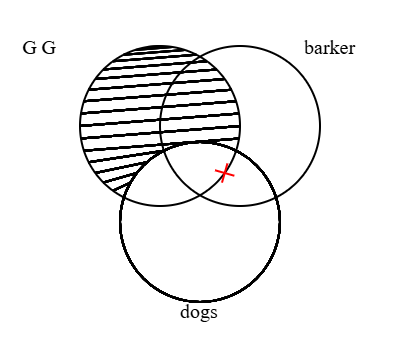
The red X in the overlap of the dog-circle and barker-circle stands for premise 1: some dogs bark.
But that X only tells you that at least one dog is in the barking region. It does not tell you which dog.
Premise 2 tells you that Guai Guai belongs somewhere inside the dog-circle. But it does not force Guai Guai into the overlap. Guai Guai could be in the barking part of the dog-circle, or in the non-barking part of the dog-circle.
That is the crux of the problem: even if the premises are true, the conclusion “Guai Guai barks” is still not guaranteed to be true.
If you’re not familiar with predicate logic, ignore the next few lines. But if you do know it, you’ll see the point immediately:
- ∃x(Dx ∧ Bx)
- D(g)
Conclusion: B(g)
That inference is not deductively valid. The existential premise says that some dog barks. It does not say that this particular dog, namely Guai Guai, barks.
The case for “informally fallacious”
Now this is where things get messy. If we interpret the Guai Guai argument not as deductive (an argument that attempts to conclude that something is logically guaranteed to be true if the premises are all true) but as inductive (an argument that attempts to conclude that something is more likely true than not—in short, a probabilistic argument), then the defect seems to be evidentiary rather than purely formal.
Revisit the argument:
Premise 1: Some dogs bark.
Premise 2: Guai Guai is a dog.
Conclusion: Guai Guai probably barks.
If “some” turns out to mean “just one dog” (which it might, because “some” means at least one), then the conclusion that Guai Guai probably barks is supported by very weak evidence.
On the other hand, if “some” turns out to mean “99% of dogs” (which is also consistent with the word “some”), then that would be enough evidence to support the conclusion that Guai Guai probably barks.
This suggests that once we explicitly add the word “probably,” the argument is no longer best criticized as a deductive screw-up. Instead, the problem is that the evidence may be too weak to support the probabilistic conclusion. That makes the defect look informal rather than formal.
So what?
The problem with this borderline case is that intro-level logic teaching often makes the formal/informal divide sound cleaner than it really is.
Intro logic books often focus on a small handful of named formal fallacies, such as:
- affirming the consequent (the COVID argument form)
- denying the antecedent
- undistributed middle
Possibly that’s because such fallacies are common, psychologically tempting, and canonically named.
But I don’t think fallacies have to be common or psychologically tempting to count as fallacies; they just have to be logically or linguistically defective. And that whole “canonically named” thing? That starts to smell a bit like dogma.
And even if broadening the term “formal fallacy” ends up making that category messier than philosophers would like, so what? If a counterexample makes the old definition unstable, that doesn’t show that the counterexample is bad. It might just show that philosophers’ understanding of the formal/informal divide is wonky and needs revision.
That’s my spiel for today. Keep thinking (and arguing).
 Philosophy without Bullshit