Is the fallacy fallacy a formal or informal fallacy?
Answer: it depends.
But first, briefly: the fallacy fallacy is the fallacy whereby the arguer concludes that an argument’s conclusion is false simply because the argument used to support it is fallacious.
For instance:
Debater 1: Trump is not evil, because you’re a cow.
Debater 2: Aha! That’s an ad hominem argument, and that’s fallacious. So you’re wrong that Trump isn’t evil. Therefore, Trump is evil.
Here, Debater 2 commits the fallacy fallacy by arguing that because Debater 1’s argument is a fallacious ad hominem abusive argument, Debater 1’s contention that Trump is not evil must therefore be false.
But the issue is this: just because someone’s reasoning is fallacious does not mean her conclusion is necessarily false. It does not mean it is true, either. It just means that the conclusion does not logically follow from that argument.
Think about it this way: if a kid were asked to do a multiplication problem—say, “2 × 2”—and, not knowing how to multiply, she used addition instead, she would still arrive at the right answer, “4,” even though her reasoning process would be wonky. It is the same way with logic and argumentation. A bad argument can accidentally land on a true conclusion.
However, the question I’ll have you ponder today is whether the fallacy fallacy is a formal or informal fallacy.
One way to interpret the fallacy fallacy is as relying on the following argument form:
Premise 1: If an argument is non-fallacious, then its conclusion is true.
Premise 2: This argument is fallacious.
Conclusion: Therefore, its conclusion is false.
If that is how the arguer is thinking, then sure: the fallacy fallacy can be understood as a formal fallacy. More specifically, it would have the form of denying the antecedent.
But here is another way to look at it. The arguer may instead be reasoning with a perfectly valid form—namely, modus ponens—while relying on a false premise:
Premise 1: If an argument is fallacious, then its conclusion is false.
Premise 2: This argument is fallacious.
Conclusion: Therefore, its conclusion is false.
If this is how Debater 2 is thinking, then the form itself is not the problem. The form is valid. The problem lies in Premise 1, which is false. In that case, the fallacy fallacy would be better understood as an informal fallacy.
So, is the fallacy fallacy a formal or informal fallacy?
Again: it depends on what, exactly, has gone wrong in the person’s reasoning.
And why does this distinction matter?
Because clarity matters. And because if we want to understand our own fallible thought processes, it helps to know whether the problem lies in the form of the reasoning or in the content of what we are assuming. But the psychology behind shitty logical reasoning is a topic for another day. Until next time, then.
In logic, words like “if,” “only if,” “if and only if,” and “unless” express different logical relationships. So if you conflate those terms and symbolize them incorrectly, you end up with confused garbage. Today’s post is on what “if,” “only if,” “if and only if,” and “unless” mean in logic.
“If”
This one is pretty straightforward. When we say “If P, then Q,” we mean that P is a sufficient condition for Q. That means that if P is true, that is enough for us to say that Q is true.
For instance, in the sentence “If Einstein is a parrot, then he is a bird,” Einstein’s being a parrot is sufficient for us to say that he is a bird. We symbolize a statement like this as follows:
P → Q
In this conditional, P is called the antecedent, and Q is called the consequent.
“Only if”
Now, that is logically equivalent to saying, “Einstein is a parrot only if he is a bird.” In ordinary language, whatever immediately follows “only if” is the necessary condition.
So the sentence “Einstein is a parrot only if he is a bird” means that being a bird is necessary for being a parrot. In other words, if it is true that Einstein is a parrot, then it must also be true that Einstein is a bird. So, once again, we symbolize the sentence like this:
P → Q
This is one reason people get confused: the phrase “only if” often makes them want to reverse the conditional. Don’t. The thing after “only if” gives you the necessary condition, not the antecedent.
Also note that this is equivalent to saying, “Only if Einstein is a bird is he a parrot.” That sounds more awkward, but the logical relationship is the same.
“If and only if”
Now consider the following sentence:
I will kick your ass if and only if you kick my ass.
This is what is called a biconditional. It means that each side is both necessary and sufficient for the other. In other words, the sentence can be broken down into two conditionals:
If you kick my ass, I will kick your ass.
If I kick your ass, you will kick my ass.
These can be symbolized as follows:
P → Q
Q → P
And those two together can be symbolized like this:
P ↔ Q
So “if and only if” means both directions hold. That is why it is stronger than plain old “if.”
“Unless”
And then there is “unless,” which seems like a pain in the ass to symbolize, but is not that hard once you get the hang of it. A useful rule of thumb is that “unless” can often be translated as “if not.”
So, “You will die unless you upload your brain to a computer” is logically equivalent to, “If you do not upload your brain to a computer, you will die.” This can be symbolized as:
¬B → D
where ‘¬’ means ‘not’, ‘B’ = ‘you upload your brain to a computer’, and ‘D’ = ‘you will die’.
So you can think of “unless” this way: “Unless B, D” means “If not B, then D.”
One last quick summary
Here is the baby-logic version:
If = sufficient condition
Only if = necessary condition
If and only if = necessary and sufficient condition
Unless = usually easiest to symbolize as “if not”
If you keep those straight, you will already be ahead of a whole lot of students who mangle conditionals into logical mush.
Apologies for the morbid tone today. Oh well. Until next time, then!
There is pseudo-profound nonsense. There is empty jargon. There is status-signaling dressed up as rigor. There are philosophers and graduate students who perform seriousness without being genuinely guided by the standards of inquiry they invoke. So if by “philosophy” you mean that sort of thing, then yes, philosophy can be bullshit.
But it does not follow that philosophy itself is bullshit any more than the existence of bad science shows that science itself is bullshit. The real question is whether philosophy, at its best, is a useless exercise in verbal fog—or whether it does something intellectually and practically significant.
My answer is: no, philosophy is not bullshit. At least, not when it is done properly.
To see why, we need to make one annoying but necessary move: we need to get clearer about what we mean by both “bullshit” and “philosophy.” Otherwise, people end up yelling past one another. One person means pseudo-profound academic fog. Another means logic, ethics, political theory, or the philosophy of language. One person means empty performance. Another means disciplined reflection on reasons, concepts, and arguments. Unless we sort that out, the question “Is philosophy bullshit?” is too muddy to answer well.
Now, trying to define philosophy in a perfectly neat way is hard, just as trying to define science in a perfectly neat way is hard. Science includes physics, chemistry, and biology, but also things like geology, medicine, neuroscience, and perhaps at least some of the social sciences. Philosophy is similarly sprawling. It includes logic, epistemology, ethics, metaphysics, political philosophy, philosophy of language, philosophy of mind, and much else besides. So instead of hunting for some magical one-sentence definition, it is more useful to ask: what does philosophy do when it is working properly?
At its best, philosophy clarifies concepts, tests reasons, exposes hidden assumptions, and asks what follows from what. It tries to distinguish what merely sounds plausible from what actually makes sense. It trains us not just to have opinions, but to examine them. And that, I think, is already enough to show why philosophy is not simply bullshit.
To answer whether philosophy is bullshit, then, we also need at least a rough grip on what bullshit is.
Let’s clear away a few common misconceptions.
Bullshit is not the same thing as lying.
Bullshit is not the same thing as falsehood.
On Harry Frankfurt’s account, bullshit is, roughly, a product of someone who is indifferent to the truth but pretends otherwise, misrepresenting herself as someone who cares. So a student who bullshits on an essay to reach a minimum word count may do so not by lying or writing what is false, but by not caring at all whether what she writes is true. She merely wants to appear as if she gives a shit so that she can get a decent score.
On my account, bullshit is, broadly put, the empty performance of norm-guided speech or conduct without being genuinely guided by the norms that make the practice intelligible. A few of the norms that make philosophy intelligible, for example, are clear argumentation, logical reasoning, and openness to criticism or objections. A philosopher who merely performs those norms while refusing to be genuinely guided by them is no longer engaged in serious inquiry. At that point, what we are seeing is not actual philosophy, but bullshit.
Now, what many people seem to mean when they say philosophy is bullshit is that philosophy is useless. But that opens another can of worms, because we would then have to clarify what “useless” means.
If by “useless” they mean that philosophy does not reliably lead to a high-paying job, then sure: philosophy is not a guaranteed path to wealth. But it would be a leap to say that because many philosophy majors do not become rich, philosophy is therefore bullshit. Poor career outcomes, even when they exist, do not show that a discipline is intellectually empty.
And even on practical grounds, philosophy is not obviously useless. Because philosophical inquiry emphasizes reading, writing, argumentation, and logical reasoning, philosophy majors tend to perform very well on standardized tests like the GRE and LSAT, and many go on to law school and careers in law, policy, business, and education. The ancient story of Thales of Miletus makes the same point in a more amusing way. According to Aristotle, Thales, annoyed at those who accused philosophers of being useless, used his intelligence to invest in the olive industry and made a fortune. “[Thales] proved,” Aristotle writes, “that philosophers can easily be wealthy if they wish, but this is not what they are interested in.”
So what are philosophers interested in?
They are interested in exercising their minds the way athletes exercise their bodies. They do this not to guarantee victory in every situation, but to build habits of discipline, responsiveness, and control that matter when things get difficult.
And I do not mean only intellectually difficult, though philosophy is certainly helpful for that. I also mean difficult in the more painful sense: your life turns to shit, and you are barely holding on.
In the 1960s, when U.S. naval officer James Stockdale was captured and tortured by North Vietnamese forces, he applied the Stoic philosophy he had learned at Stanford to remain sane. When Marcus Aurelius led the Roman Empire, he drew on the same philosophical tradition to maintain equanimity while confronting war, plague, and political burden.
So I am not saying that philosophy matters only in classrooms or journals. At one of the worst moments of my life, a philosopher once gave me a simple argument that helped keep me alive.
Sometimes, clear thinking is not an academic luxury. Sometimes, it is what makes life bearable. And often, it is what makes life worthwhile.
So, is philosophy bullshit?
Sometimes, yes—when it degenerates into pseudo-profound fog, empty performance, or jargon without guidance. But philosophy itself is not bullshit when it does what it is supposed to do: clarify, test, examine, and help us think more clearly about what matters.
Try it seriously, and that much should become obvious.
Formulated more clearly, the argument looks like this:
Premise 1: Traffic is bad.
Conclusion: Therefore, I will be late.
That looks fine at first glance, but there is a missing premise that we would need to make explicit for the argument to deductively support the conclusion. In other words, the argument looks more like this:
Premise 1: Traffic is bad.
Premise 2: ?
Conclusion: Therefore, I will be late.
So what is the missing premise? People often guess things like, “I’m driving,” or “I’ll be stuck in traffic.” Those are reasonable guesses, but they are still not enough to make the argument deductively valid. To do that, we would need a hidden premise like this:
Premise 1: Traffic is bad.
Premise 2: If traffic is bad, I will be late.
Conclusion: Therefore, I will be late.
Now the argument has the form of modus ponens, perhaps the most basic rule in logic. Briefly, modus ponens is:
P
P Q
∴ Q
where ‘P’ = ‘Traffic is bad’, ‘P Q’ = ‘If traffic is bad, I will be late’, and ‘∴ Q’ = ‘Therefore, I will be late.’
Arguments like this one, containing at least one hidden premise or unstated conclusion, are called enthymemes.
Now, not all enthymemes are sneaky in a bad way. We leave premises unstated all the time because ordinary conversation would be unbearably tedious if we said every single thing out loud. Enthymemes become sneaky when the missing premise is exactly the part of the argument that is weakest, most controversial, or most in need of scrutiny.
That is why they matter so much.
If you fail to identify premise 2 (“If traffic is bad, I will be late”), then you have one fewer premise to target in the argument. You may find yourself trying to disprove premise 1 (“Traffic is bad”), which, if the traffic actually is bad, would make it much harder to criticize what is really going on.
But once we identify the hidden second premise, we begin to understand what to target: is premise 2 true? Is it really the case that if traffic is bad, then the speaker will necessarily be late?
Once we begin to question that previously hidden premise, we can come up with counterexamples. We can say: “If traffic is bad, you can still arrive on time.” Why? Because:
you can take the metro
you can work remotely
you may already have built in extra travel time
you may live close enough to walk
This is an easy example, but things start to get trickier once we get into advertisements and political arguments.
Consider this fictional advertisement that I made up just now:
Do you like being pampered? Do you want to be attractive, alluring, charming, sexy, whatever it is that floats your boat? Then you must apply our proprietary Bullshit Lotion.
First, let’s try to figure out what the argument is actually saying:
Premise 1: You like being pampered and you want to be attractive/alluring/charming/sexy/whatever.
Conclusion: Therefore, you must apply our proprietary Bullshit Lotion.
Once we do that, the missing second premise becomes obvious. The argument is really saying:
Premise 1: You like being pampered and you want to be attractive/alluring/charming/sexy/whatever.
Premise 2: If you like being pampered and you want to be attractive/alluring/charming/sexy/whatever, then you must apply our proprietary Bullshit Lotion.
Conclusion: Therefore, you must apply our proprietary Bullshit Lotion.
Now that we’ve identified the missing second premise, we can cast doubt on it.
Is it true that if you like being pampered and want to be attractive, etc., then you must apply the proprietary Bullshit Lotion? Perhaps not. Perhaps you can apply some other brand of lotion. Perhaps you do not need lotion at all. Or perhaps, if you want to be pampered and attractive, you can just go to a spa. You get the point.
Or take, for example, political enthymemes. Suppose that a politician says:
“My opponent wants to cut the military budget. So my opponent is weak on national security.”
What is the missing premise? And how might you cast doubt on that premise by providing plausible counterexamples?
I’ll leave that as a little exercise for you. But now you can see why enthymemes are so sneaky: what is doing the most argumentative work is often the very thing left unsaid.
In her 2025 paper “Bullshit Philosophy,” Rima Basu argues that bullshit philosophical inquiry is both a moral and epistemic wrong. My focus for this post is on the epistemic implications of bullshit in philosophy, so it’s nice that Basu cleanly outlines her argument that bullshit philosophical inquiry is epistemically damaging:
(1) Philosophy aims at understanding.
(2) The principle of charity is a constitutive methodological principle central to any epistemic practice that takes understanding as its aim.
(3) Therefore, the principle of charity is a constitutive methodological principle central to philosophy.
Basu gives a concrete example of how bullshit philosophical inquiry might arise in the case of a PhD candidate trying to pass her thesis defense. A committee member asks the candidate a question, and the candidate, unable to answer the question, proceeds to bullshit: she carefully responds with a string of true statements that are irrelevant to the question asked, hoping that the irrelevance of these statements would pass unnoticed.
Perhaps, Basu says, if the candidate is very lucky, the committee member might even charitably reconstruct those true statements so that they seem relevant to the question asked, providing the candidate with an argument where there was none. She states, “[W]e are at risk of confabulating something, anything, to make what is said make sense, to grasp at some underlying connection when there was no underlying connection in the first place.”
Basu’s math analogy and its flaws
Then Basu offers this analogy:
“In this way, PhD Candidate resembles a math teacher who asks her students to show the work for arriving at answers to a problem set while knowing full well that some of the answers she provided in the worksheet might be wrong, because she copied them out of the textbook in haste. Imagine attempting to complete that worksheet. Although the answers may seem impossible, because we generally defer to authority figures like teachers, we convince ourselves that they must be possible. It is due to our intellectual failures that we can’t arrive at the answer the worksheet says we should be able to arrive at.”
But this analogy, which is supposed to do significant work in support of Basu’s argument, is inapt.
Notice first that the hypothetical scenario stipulates that the PhD candidate carefully selects a string of true, if irrelevant, statements. That is obviously not what the sloppy math teacher, who knows “full well that some of the answers she provided in the worksheet might be wrong, because she copied them out of the textbook in haste,” does.
This is a crucial difference: for Basu’s argument to work, she must show that this type of bullshit philosophy, where the PhD candidate carefully selects only true statements, does epistemic damage. But she then attributes the epistemic damage to the confabulation that may result from false answers, as in the math analogy. So Basu has not clearly shown that the bullshitter PhD candidate causes epistemic damage the way the sloppy math teacher does.
For the analogy to be more apt, we have to reconstruct it as follows:
The math teacher copies the answers carefully, ensuring that the answers for which her students must show their work are correct. But the math teacher does not understand how the correct answers connect to the work shown. She does not understand why the answers are correct.
This is much more analogous. Both the PhD candidate and the math teacher carefully produce answers that are true, but both are bullshitting in the sense that they lack understanding.
But with this revised analogy, it becomes difficult to see how the math teacher—and, by extension, the PhD candidate—cause epistemic damage. The math students may very well conscientiously show their work and gain a better understanding of math even if their teacher doesn’t understand how the math works. The committee member, too, may gain deeper philosophical understanding despite the PhD candidate’s bullshit (but true) responses.
Indeed, one might even argue that the PhD candidate could come away with greater philosophical understanding than she would have if she had simply said “I don’t know,” provided that the committee’s charitable reconstruction reveals a genuinely interesting line of thought. Given that she truly wants to pass her thesis defense, she would need to understand the reconstructed argument that the committee member charitably offered so that she could come up with better answers for the rest of the defense. As admirable as it would have been if she had simply said, “I don’t know,” neither she nor the committee member would likely have come up with the stronger reconstructed argument. That would have been as if the math teacher, unable to understand the connection between the math answers and the work, simply admitted to her students, “I don’t understand how this math works, so I’m not assigning you any worksheet.”
Thus, even if bullshit inquiry is bad, the audience’s charitable and exploratory response to it need not be bad. In philosophy, that response may sometimes still generate genuine understanding.
Incidentally, there is also a second problem with Basu’s analogy. The math case is structurally convergent: students are trying to derive one determinate answer, and if that answer is wrong, their effort is likely to misfire. Philosophy is often much more divergent. Faced with a question, philosophers regularly generate multiple candidate interpretations, distinctions, and lines of thought. What Basu describes as a risk of “confabulation” may, in philosophy, sometimes be part of the ordinary process by which understanding is produced. Even if the PhD candidate lacks understanding, the committee’s charitable attempt to draw connections among the candidate’s true claims may still deepen the committee’s own understanding rather than undermine it.
The takeaway
Basu’s argument seems caught in a dilemma. If the math analogy is left as she presents it, it is not genuinely parallel to the PhD-candidate case, because it relies on false answers rather than true-but-irrelevant ones. But if the analogy is repaired so that it becomes genuinely parallel, the alleged epistemic harm is no longer obvious. In both the repaired math case and the philosophical case, the audience’s charitable reconstruction may still generate understanding rather than undermine it.
So Basu has not yet shown what she needs to show: that bullshit inquiry, in the form she describes, is epistemically damaging in a way that undermines philosophy itself. At most, she has shown that such inquiry may shift onto others the burden of making sense of what the bullshitter says. But that is not the same thing as proving that charity here is epistemically corrupting rather than epistemically productive.
In philosophy, charity may sometimes rescue bullshit. But in rescuing it, it may also produce the very understanding Basu says bullshit inquiry undermines.
So it’s been around 18 years since my first girlfriend dumped me, but while I have long gotten over it, I have not come to terms with the stupidity of her argumentative strategy. Consider the first part of her argument:
“What your father does is wrong. Why? Because I feel really strongly about it.”
I asked her why she feels “really strong about it.” She responded:
“Because it’s wrong.”
This circular reasoning—this is what philosophers call begging the question—went on for a good fifteen or thirty minutes.
Today, we’re looking at the informal fallacy of begging the question. You just read an obvious example. Now, we’re going to look at some subtler instances.
Christopher W. Tindale has us consider, in his Fallacies and Argument Appraisal, the following arguments:
Example 1:
A heavier-than-air craft could never fly because in order to lift up and travel over distance a machine would have to be lighter than the environs surrounding it.
Example 2:
God is the only perfect being and perfection includes all the virtues. So, we know that God is benevolent.
He then asks two critical questions to identify instances of begging the question:
Critical question 1:
Has the arguer avoided the obligation to provide independent support for a claim by restating it in similar terms?
Critical question 2:
Has an arguer avoided the obligation to provide independent support by assuming somewhere in the premises the very thing that has to be shown?
I’m going to add one more question to the list:
Critical question 3:
Do the premise(s) and conclusion depend on each other for justification?
These questions will help us articulate how Example 1, Example 2, and the ex-girlfriend example beg the question.
First, there is no real question when someone begs the question
Let’s disabuse ourselves of a potential source of misunderstanding. Nobody’s really asking a question when they commit the “begging the question” fallacy. Here, the word “question” is better understood as the “issue at hand.” If, for instance, a Bible thumper tells you,
“God exists because the Bible says so, and the Bible is the word of God”
it’s not that anyone is asking a question. It’s that the arguer presumes the issue at hand—namely, whether God exists—to be true, when that is exactly what she needs, but fails, to independently support.
In other words, the premise “the Bible is the word of God” hides the assumption that God exists. So duh, if she cheats like that, of course she can (fallaciously) reach the conclusion that God exists. She’s basically saying:
God exists because God exists.
Restating a claim in similar terms
Here’s critical question 1 again:
Has the arguer avoided the obligation to provide independent support for a claim by restating it in similar terms?
Now revisit Example 1:
A heavier-than-air craft could never fly because in order to lift up and travel over distance a machine would have to be lighter than the environs surrounding it.
This one’s sneaky. But yes—the arguer has avoided the obligation to provide independent support by restating the claim in different terms.
Briefly:
“Heavier-than-air craft” ≈ “machine” that is not “lighter than the surrounding air”
“Fly” ≈ “lift up and travel over distance”
These expressions are not strictly identical, but they function the same way in the argument.
So the arguer hasn’t explained anything. She’s just saying:
A heavier-than-air craft cannot fly because a heavier-than-air craft cannot fly.
Sneaking the conclusion into the premises
Reconsider this argument:
God is the only perfect being and perfection includes all the virtues. So, we know that God is benevolent.
Sounds good, right? Good my ass.
Rephrased, the argument goes like this:
Premise 1: God is the only perfect being.
Premise 2: A perfect being has all the virtues (including benevolence).
Conclusion: God is benevolent.
This looks like an argument, but it isn’t doing any real work. The conclusion is already built into the premises.
So while it doesn’t look like “G, therefore G,” that’s basically what’s going on under the hood.
Mutually dependent premise and conclusion
Now back to the ex-girlfriend argument:
I feel really strongly about what your father does. Therefore, what your father does is wrong.
What your father does is wrong. Therefore, I feel really strongly about it.
If this were an Escher drawing, it’d be a masterpiece.
Recall critical question 3:
Do the premise(s) and conclusion depend on each other for justification?
Here, the answer is yes.
Each claim is being used to justify the other. That’s classic circular reasoning.
You might be tempted to ask whether circular reasoning and begging the question are really the same thing. Fair question—but we don’t need to settle that here. For now, it’s enough to see how these arguments go wrong.
A psychological note on begging the question
In A System of Logic, John Stuart Mill observes that people are unlikely to commit this fallacy in their own private reasoning, but they do commit it in dialogue.
My guess is this: people know their reasons are weak, but instead of admitting it, they just restate their conclusion in slightly different words and hope no one notices.
René Descartes walks into a bar and orders a drink. When he finishes his drink, the bartender asks him if he would like another. Descartes replies, “No, I think not,” and disappears in a puff of logic.
Philosophers are probably not amused… not because the joke talks crap about Descartes (it doesn’t), but because its attempt at humor rests on a misunderstanding of basic logic. In fact, there are two fallacies at play here: equivocation and denying the antecedent.
Equivocation
Equivocation is a fallacy where a word or phrase has two different meanings that are mistakenly lumped together as one. This is an informal—not formal—fallacy. That is, the fallacy arises not from the logical form of the argument, but from the content of the argument. Take this meme:
The Bible says being gay is fine, as long as you’re high.
Why? Because…
“A man who lays with another man should be stoned.”
–Leviticus 20:13 ESV
The fallacy hinges on a (deliberate) equivocation on the word “stoned,” which can mean two things: (1) to be high and (2) to be executed by stoning.
Applied in a deductive argument, equivocation might look like this:
Premise 1: Saint Stephen was stoned.
Premise 2: If you’re stoned, you’re allowed to be gay.
Conclusion: Therefore, Saint Stephen was allowed to be gay.
Here, the form of the argument is what we call modus ponens, a deductively valid move in logic. But the content of the argument—specifically, the two distinct meanings of “stoned” in the premises—is conflated, creating an informal fallacy.
Equivocation in the Descartes joke
So where does equivocation fit in the Descartes joke?
“I think not.”
This has two different meanings:
“I think not”1 = “I don’t think so”
“I think not”2 = “I am not thinking”
The joke exploits this ambiguity, going from “I think not” in the first sense to “I think not” in the second.
Denying the antecedent
This is where it gets pretty stupid. Besides equivocation, the fallacy of denying the antecedent—a formal fallacy—must be applied for the joke to work at all.
Briefly:
Denying the antecedent:
P → Q
¬P
∴ ¬Q
This says:
If P, then Q
Not P
Therefore, not Q
This is invalid because Q could still be true for some other reason. But it’s a tempting mistake. Some instances of denying the antecedent look convincing at first glance:
Premise 1: If I die, I’ll be in hell.
Premise 2: I’m not dead.
Therefore, I’m not in hell.
But the fallacy becomes more obvious once we change the content:
Premise 1: If that’s a turtle, then that’s a reptile.
Premise 2: That’s not a turtle.
Therefore, that’s not a reptile.
Clearly, an animal can be a reptile without being a turtle.
In the case of the Descartes joke, the implied argument is:
If I think, I exist.
I think not (that is, I am not thinking).
Therefore, I don’t exist.
Same form, different content.
So there you go—a seemingly funny joke ruined by a brief logical analysis, which I find funnier than the joke itself.
And they say that Descartes “disappears in a puff of logic”?
Philosophers draw a distinction between formal fallacies and informal fallacies.
Formal fallacies
Roughly, a formally fallacious argument is a deductively invalid argument where the form of the argument is wonky. Take, for example:
Premise 1: If I have COVID, then I display symptoms X.
Premise 2: I display symptoms X.
Conclusion: Therefore, I have COVID.
The form of this (bad) argument is:
C → D
D
Therefore C
Note that the conditional (if…then) is symbolized by an arrow going from left to right. That means C gets you D. But that doesn’t mean D always gets you C.
For instance, if it’s true that having COVID implies that I display symptoms X, I can’t conclude from the fact that I display symptoms X that I have COVID—because after all, I might have some other non-COVID lung problem that’s causing those symptoms.
And sure, it might also turn out that I do have COVID after all, but that possibility doesn’t make the argument any less fallacious. The problem is not that the conclusion happens to be false. The problem is that the form of the argument allows for a case where the premises are true and the conclusion is false. That is what makes it deductively bad. So:
fallacy ≠ false
formal fallacy = a deductive argument whose form does not guarantee the conclusion
Here’s another example:
Premise 1: If that’s a dog, then that’s a mammal.
Premise 2: That’s a mammal.
Conclusion: Therefore, that’s a dog.
The form here is identical to the (bad) argument about COVID. We have:
D → M
M
Therefore D
But this one is very obviously fallacious.
Again, it’s fallacious not because the conclusion happens to be false (it might very well turn out that the mammal is a dog), but because even if the premises are all true, you still can’t say for certain that the conclusion is true.
Informal fallacies
So where do informal fallacies come in?
Take something that is, in classical logic, both necessarily true and formally correct:
A = A
or
A
therefore A
And say that someone asks you this:
“Who is the current president of the United States?”
You respond with this argument:
John Adams is the current president of the United States. Why? Because John Adams is the current president of the United States.
That’s stupid—not because there’s anything wrong with the form of the argument, which is simply A, therefore A, but because the argument is rhetorically useless and question-begging. It gives the hearer no independent reason whatsoever to accept the claim.
So the John Adams argument is stupid due to something that logical form alone cannot capture, namely, some conversational, rhetorical, epistemic (knowledge), or other informal aspect of language itself.
Or take this example, taken from an old DirecTV commercial:
“When you pay too much for cable, you feel down. When you feel down, you stay in bed. When you stay in bed, they give your job to someone new. When they give your job to someone new, he has a lot to learn. When he has a lot to learn, mistakes are made. And when mistakes are made, you get body-slammed by a lowland gorilla. Don’t get body-slammed by a lowland gorilla. Get rid of cable, and upgrade to DirecTV.”
The chain part of the argument has a deductively valid form. It’s basically:
A → B
B → C
C → D
D → E
E → F
F → G
So:
A → G
Now, to get from there to “therefore don’t pay too much for cable,” you need at least one additional premise—something like this:
¬G
Therefore ¬A
And even if you generously grant the commercial that extra anti-gorilla premise, what’s still fallacious is not the logical form. The form is fine. What’s fallacious is the evidentiary stuff: the more links you have in a chain argument, the more evidence you need to justify each link. Is there enough evidence to say that “when mistakes are made, you’ll get body-slammed by a lowland gorilla”? No. And the same goes for several of the other links.
Where the line blurs
An interesting issue arises when we consider borderline cases of fallacies. Take this one:
Premise 1: Some dogs bark.
Premise 2: Guai Guai is a dog.
Conclusion: Guai Guai (probably) barks.
It’s unclear whether this is best treated as formally or informally fallacious.
The case for “formally fallacious”
If we ignore the word “probably” and interpret this as a deductive argument, the argument is deductively invalid because the form does not guarantee the conclusion.
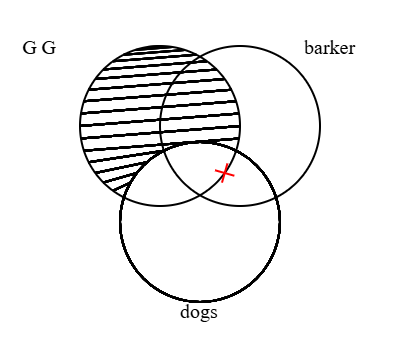
You can illustrate that with a neat little Venn diagram like this one.
The red X in the overlap of the dog-circle and barker-circle stands for premise 1: some dogs bark.
But that X only tells you that at least one dog is in the barking region. It does not tell you which dog.
Premise 2 tells you that Guai Guai belongs somewhere inside the dog-circle. But it does not force Guai Guai into the overlap. Guai Guai could be in the barking part of the dog-circle, or in the non-barking part of the dog-circle.
That is the crux of the problem: even if the premises are true, the conclusion “Guai Guai barks” is still not guaranteed to be true.
If you’re not familiar with predicate logic, ignore the next few lines. But if you do know it, you’ll see the point immediately:
∃x(Dx ∧ Bx)
D(g)
Conclusion: B(g)
That inference is not deductively valid. The existential premise says that some dog barks. It does not say that this particular dog, namely Guai Guai, barks.
The case for “informally fallacious”
Now this is where things get messy. If we interpret the Guai Guai argument not as deductive (an argument that attempts to conclude that something is logically guaranteed to be true if the premises are all true) but as inductive (an argument that attempts to conclude that something is more likely true than not—in short, a probabilistic argument), then the defect seems to be evidentiary rather than purely formal.
Revisit the argument:
Premise 1: Some dogs bark.
Premise 2: Guai Guai is a dog.
Conclusion: Guai Guai probably barks.
If “some” turns out to mean “just one dog” (which it might, because “some” means at least one), then the conclusion that Guai Guai probably barks is supported by very weak evidence.
On the other hand, if “some” turns out to mean “99% of dogs” (which is also consistent with the word “some”), then that would be enough evidence to support the conclusion that Guai Guai probably barks.
This suggests that once we explicitly add the word “probably,” the argument is no longer best criticized as a deductive screw-up. Instead, the problem is that the evidence may be too weak to support the probabilistic conclusion. That makes the defect look informal rather than formal.
So what?
The problem with this borderline case is that intro-level logic teaching often makes the formal/informal divide sound cleaner than it really is.
Intro logic books often focus on a small handful of named formal fallacies, such as:
affirming the consequent (the COVID argument form)
denying the antecedent
undistributed middle
Possibly that’s because such fallacies are common, psychologically tempting, and canonically named.
But I don’t think fallacies have to be common or psychologically tempting to count as fallacies; they just have to be logically or linguistically defective. And that whole “canonically named” thing? That starts to smell a bit like dogma.
And even if broadening the term “formal fallacy” ends up making that category messier than philosophers would like, so what? If a counterexample makes the old definition unstable, that doesn’t show that the counterexample is bad. It might just show that philosophers’ understanding of the formal/informal divide is wonky and needs revision.
That’s my spiel for today. Keep thinking (and arguing).
I’m going to attempt the impossible in this post: explain something that confused me and pissed me off so much in grad school that it became one of the (many) reasons I quit the program. But it’s been a decade since I left, and now that there’s no pressure to publish papers, meet deadlines, and pass the damn courses, it’s time to revisit this shit with a vengeance.
Metalogic — what in the actual fuck does that even mean?
We’ll lay down some foundational metalogic concepts first so we can tackle what’s called the soundness theorem in metalogic within what’s called the Hilbert system, not just as a vague example, but with as much precision as possible—while translating every piece of symbol garbage into normal human English.
The calculator analogy
Say you have a calculator.
2 + 2
and it spits out:
4
Cool. That’s just doing math.
That’s like doing a normal logic problem: you follow rules → you get an answer.
But metalogic asks something way more annoying:
“How do you know the calculator won’t randomly give you 5 or 10 or 17 one day?”
Not just for 2 + 2.
But for:
17 + 83
999 + 1
ANY numbers you plug in
So we’re not checking answers.
We’re checking whether the system itself ever screws up.
What we need to show
To prove the system is reliable, we need four things:
Premises
Axioms
Rule Case
Inductive Step
I’ll explain what the hell these things mean using analogies along the way.
(1) Starting assumptions (premises)
These are just things you’re told to start with.
Math analogy:
You get a math problem. It says assume that x = 5.
You don’t question the math problem and say shit like, “How do you know that x = 5? Can you prove it? No? Then shut the fuck up.”
Instead, you say, “Cool, let’s just say that x = 5 is true.”
Chess analogy:
Say that you’re playing a game of chess. You’re given a starting position: the white queen is on one square, the black queen is on another, the rooks are in the corners, and so on. You don’t say, “How do we know that’s where these pieces begin?” You just assume those positions are correct and move on.
Logic example:
Statement 1: If you eat Taco Bell, you’ll have diarrhea.
Statement 2: You eat Taco Bell.
…you don’t question whether these two statements are true. You assume they’re true for the sake of argument. If we want to add a few scary logic symbols, we write:
Γ = { Taco Bell, Taco Bell → diarrhea }
Translation (without the hieroglyphics)
Γ (the big scary Greek letter gamma) just means:
“the set of starting assumptions”
So this is just a fancy way of saying:
“Here are the things we’re starting with. This is like ‘assume x = 5’ in a math problem or a given starting position in a game of chess. Don’t question them (for now).”
Even simpler
Γ =
Taco Bell
If Taco Bell → diarrhea
That’s it.
No magic.
Important clarification (so nobody loses their mind)
We are NOT saying:
“Taco Bell is actually true in real life”
We are saying:
“Assume it’s true. Now let’s see what follows.”
One-line takeaway
Premises are just the starting point of the game—not guaranteed truth, just assumed truth.
(2) It starts with stuff that can’t be wrong (axioms)
Axioms are different from premises.
Premises are just assumptions you start with.
Axioms are patterns that come out true no matter what you plug into them.
Math analogy:
x = x.
No matter what number you plug in for x, it always comes out true. There is no situation where a thing is not equal to itself.
Chess analogy:
There are some things built into the chess system itself. One piece can’t occupy two squares at once. Two pieces can’t occupy the same square. If that happened, the game would already be broken before it even began.
Now here’s where my past self would start getting pissed off:
“Why the fuck are we allowed to just say this can’t be wrong? Aren’t we just assuming that?”
That sounds like what’s happening—but that’s not actually what’s going on. In logic and metalogic, it has something to do with a possible situation.
What the hell is a “possible situation”?
In logic, a “possible situation” does NOT mean:
some weird sci-fi universe
or “anything you can imagine”
It means something much more boring:
a way of assigning true or false to statements
That’s it.
That’s what truth tables are doing.
So we’re not assuming—it’s more like checking every possible truth assignment
Take a typical logical axiom:
“If A, then (if B, then A)”
Now we check ALL possible truth assignments:
A
B
B→A
A→(B→A)
T
T
T
T
T
F
T
T
F
T
F
T
F
F
T
T
This means:
If A = true and B = true, then A→(B→A) is true.
If A = true and B = false, A→(B→A) is still true.
If A = false and B = true, A→(B→A) is true yet again.
If A = false and B = false, A→(B→A) is true too.
We’ve exhausted all the possible situations, or all possible truth assignments. Whatever true/false shit you might assign A and B, A→(B→A) always comes out true.
In other words:
Does this thing EVER come out false?
No.
Not even once.
So we’ve proved that this is a legit axiom. That means we’ve proved that what we’re starting with can never spit out garbage.
Important clarification
You might say, “Hey, dumbass, what if I define a situation where A and ¬A are both true?”
For example:
A
¬A
T
T
F
F
Cool.
But then:
you’ve changed the rules of the game
You’re no longer doing classical logic.
And if you change the rules, then yes:
you have to redo the whole soundness proof for that new system
Final translation of “axiom”
Axioms aren’t trusted because we feel like it. They’re trusted because, given the system’s definition of truth, we can check every possible case—and they never come out false.
(3) The rules never mess things up (rule case)
Now we check the rules.
Math analogy:
Suppose you know:
2 + 2 = 4
4 + 4 = 8
Now you apply a rule:
“If a = b, then you can replace a with b”
So from:
2 + 2 = 4
you’re allowed to treat 4 as interchangeable with 2 + 2.
So (2 + 2) + 4 = 8.
This math rule never messes up.
Chess analogy:
Bishops move diagonally.
So if your bishop starts on a black square, it will always stay on black squares.
And if your bishop starts on a white square, it will always stay on white squares.
So the rule “bishops move diagonally” will never randomly make a bishop jump from a white square to a black square, or from a black square to a white square, or do some other crazy shit.
In logic, here’s the big rule:
Modus Ponens
A
If A → B
Therefore:
B
Concrete example
Metalogic is gay.
If metalogic is gay, Raymond’s ass is demolished.
Therefore:
Raymond’s ass is demolished.
Now here’s the important part
This isn’t about THAT specific sentence.
It’s about the form.
You can swap in anything:
Example 2
You eat Taco Bell.
If you eat Taco Bell, you’ll have diarrhea.
Therefore:
You’ll have diarrhea.
Example 3
I didn’t sleep.
If I didn’t sleep, I’m miserable.
Therefore:
I’m miserable.
Example 4
I make poop jokes.
If I make poop jokes, I’m childish.
Therefore:
I’m childish.
The key question
Is there ANY situation where:
A is true
“If A then B” is true
but B is false?
No.
There is no such situation.
Again, in intro to logic class, you can use a truth table to check this:
A
B
A → B
T
T
T
T
F
F
F
T
T
F
F
T
The only row where A is true and A → B is true is the first row. And in that row, B is true too.
Therefore:
This rule NEVER turns truth into bullshit.
(4) If every step is good, the whole thing is good (inductive step)
This is where grad school says:
“We proceed by induction”
and everyone (well, me, at least) dies inside.
Again, we’ll first use the math analogy.
Start with:
2 + 2 = 4
4 + 4 = 8
8 + 8 = 16
Notice something:
You’re always adding an even number to an even number.
And every time:
you get an even number
Now the key idea
If:
even + even = even (this NEVER fails)
Then:
no matter how many times you repeat this process, you’ll ALWAYS get an even number.
That’s the inductive step
You’re not checking:
just the first step
just the second step
You’re saying:
“This pattern keeps working forever.”
And how do we know it works forever? We know not because we’ve checked a bunch of numbers and got tired and said, “Fuck it, it works for all numbers for infinity.” It works because we get the form of the math. That is,
2a + 2b = 2(a + b)
Steel staircase analogy:
You’re building an infinite staircase. The first step you build is made of solid steel. It doesn’t collapse. The second step is built the exact same way. It doesn’t collapse. The third step is also built identically to the second. So it’s impossible for the entire staircase to collapse.
Why?
Not because you checked a few steps and said, “Cool, it works for all the steps.” It’s because the way each step is built is identical to the next.
Chess analogy:
If every move you make is legal, and every move is made according to the same rules, then the entire game stays legal. The board won’t suddenly sprout a third king or summon a UFO to suck away your pieces halfway through the game.
Translation
If every step in your reasoning is safe, then the final result is safe.
Conclusion
If your eyes glazed over, don’t worry. Just keep this in mind:
Every line in a logical proof is either:
a given assumption/premise (like x = 5)
an axiom (like If A, then (if B, then A))
the result of applying a rule (like modus ponens)
And induction is the method that lets us say:
if every step is safe, then the whole proof is safe
So if premises don’t start us with bullshit, axioms never spit out bullshit, and rules never turn truth into bullshit, then the whole logical system we’re checking is legit.
In other words:
If you can prove it (using the logical system you’re checking) (⊢), it’s true (⊨).
That’s all for today. In a future blog post, I’ll take you through the proof for the soundness theorem step by step, using the Hilbert system.
“Deductive arguments go from general to specific.” “Inductive arguments go from specific to general.”
This is repeated so often that even professors say it.
Unfortunately, it’s wrong.
And if I hear one more person say that, I’m gonna have a fucking seizure.
First: what an argument actually is
An argument = a set of statements, a.k.a. premises, that lead to a conclusion.
So this is an argument:
Premise 1: If I hear one more person say “deductive arguments go from general to specific,” I’m gonna have a fucking seizure.
Premise 2: I hear one more person say “deductive arguments go from general to specific.”
Conclusion: Therefore, I’m gonna have a fucking seizure.
The form, or structure, of the argument is:
H → S
H
Therefore, S
That logical move, by the way, is called modus ponens. It’s a valid and “duh” move, yes, but the Latin makes it sound deep, and it’s exactly the kind of structure all deductive logic is built on.
In logic, an argument is NOT defined as:
yelling
a claim (like “postmodern art is valuable, but postmodernism is not”–sounds deep, but that’s just a claim/statement)
an opinion (including the ones everyone and their uncle feel entitled to express)
disagreement
What deduction REALLY is
Deductive validity
Deduction means:
If the premises (of an argument) are true, then the conclusion must be true.
In other words:
The truth of the premises guarantee the truth of the conclusion.
So, if ‘H → S’ (premise 1) is true, and if H (premise 2) is true, then S (conclusion) must be true.
Specifically, that’s what we call a deductively valid argument.
Notice I kept on italicizing the word if. That’s because that’s super important–after all, one or more of these premises might not be true. For example, is premise 2 (“If I hear one more person say “deductive arguments go from general to specific,” I’m gonna have a fucking seizure”) true? No. So deductive validity doesn’t mean that the conclusion of your argument is true. It just means, again, that
if the premises are all true, then the conclusion must be true.
Deductive soundness
But what if you have a valid argument and its premises are all true? For example:
Premise 1: If I don’t have any money, I can’t pay the mortgage. (TRUE)
Premise 2: I don’t have any money. (TRUE)
Conclusion: I can’t pay the mortgage. (BOTH LOGICALLY AND IN REALITY GUARANTEED TO BE TRUE)
Then this deductive argument is what is called sound.
A word on that bullshit definition of “deduction”
Note that in neither the seizure example nor the mortgage example is anything “going from general to specific.” That’s because “going from general to specific”is simply not the correct definition of “deduction,” nor is it useful for a deeper understanding of how arguments work. But some teachers and professors will still use that definition no matter how many times I object. Whatever. Let’s move on.
What induction REALLY is
Inductive logic does not use labels like “valid” or “sound.” Instead, we use words like “weak,” strong,” and “apt.” This different terminology is important because, unlike deduction, induction is probabilistic.
Inductive weakness
Consider this argument:
Premise 1: Some dogs bark.
Premise 2: Guai Guai is a dog.
Conclusion: Guai Guai (probably) barks.
This is an inductively weak argument becauseof what the word “some” means.
“Some dogs” might be just 1% of dogs. “Some dogs” might even be just 0.01% of dogs. There simply isn’t enough reason for us to accept the conclusion that Guai Guai probably barks because, by definition, probably = roughly put, “more likely than not” or “high enough likelihood given the evidence.” And the word “some” is simply too weak to conclude that Guai Guai’s barking is probable.
Inductive strength
Now what about this one?
Premise 1: Most Martians like Dr. Seuss.
Premise 2: Zorp is a Martian.
Conclusion: Zorp (probably) likes Dr. Seuss.
This is an inductively strong argument. “Most Martians” doesn’t mean some exact math like 51%. It just means a strong majority—enough to make the conclusion actually likely. So that–and the fact that Zorp is a Martian–makes it probable that Zorp likes Dr. Seuss.
Inductive aptness
What happens when you have an argument that is inductively strong and all its premises are true? That’s when you have an inductively apt argument. Let’s go back to the dog argument and change it a little:
Premise 1: Most dogs bark.
Premise 2: Guai Guai is a dog.
Conclusion: Guai Guai (probably) barks.
This dog argument has a form that is identical to that of the Martian argument, so it is obviously inductively strong. But unlike the Martian argument, the dog argument has premises that are all true. Hence, it is inductively apt.
A word on that bullshit definition of “induction”
Note that none of these inductive arguments “go from specific to general.” That’s because, like the bullshit-y definition of deduction, the bullshit-y definition of induction is not very helpful for a deep understanding of how arguments work. And yet, textbooks teach that definition. Perhaps I will be having that fucking seizure after all.
Another type of argument: abduction
There’s at least one other type of argument–the abductive argument–that we can discuss. Abduction, or inference to the best explanation (IBE), aims to reach conclusions based on the best possible explanation. Ockham’s Razor–the principle that the best explanation is the simplest one that makes the least number of assumptions–is a case in point. For instance:
Suppose you walk into your living room and see that:
The floor is wet
Your dog is shaking water everywhere
There’s a knocked-over bowl of water
You could come up with many explanations:
A pipe burst
Someone broke in and spilled water
Your dog knocked over the bowl
But one explanation stands out as the best:
Your dog knocked over the bowl and made a mess.
That’s an abductive argument:
The floor is wet and the bowl is knocked over. If the dog knocked over the bowl, that would explain all this shit. Therefore, the dog probably knocked over the bowl.
Notice what’s happening here:
You’re choosing the explanation that best fits the evidence.
A brief note on abduction and probability
Abduction is often treated as probabilistic, even if people don’t always say it that way.
When you say “this is the best explanation,” what you usually mean is something like:
This explanation makes the observed evidence more likely than the alternatives.
That’s exactly the kind of reasoning philosophers like Elliot Sober analyze using probability. (Check out his book, Ockham’s Razors.)
So if someone tells you that abduction is “not probabilistic,” they’re either oversimplifying or just wrong.
Conclusion
If you forget most of what I just said, remember this one thing:
The difference between deductive and inductive arguments has nothing to do with “general vs. specific.” It has to do with certainty vs. probability.
 Q
Q